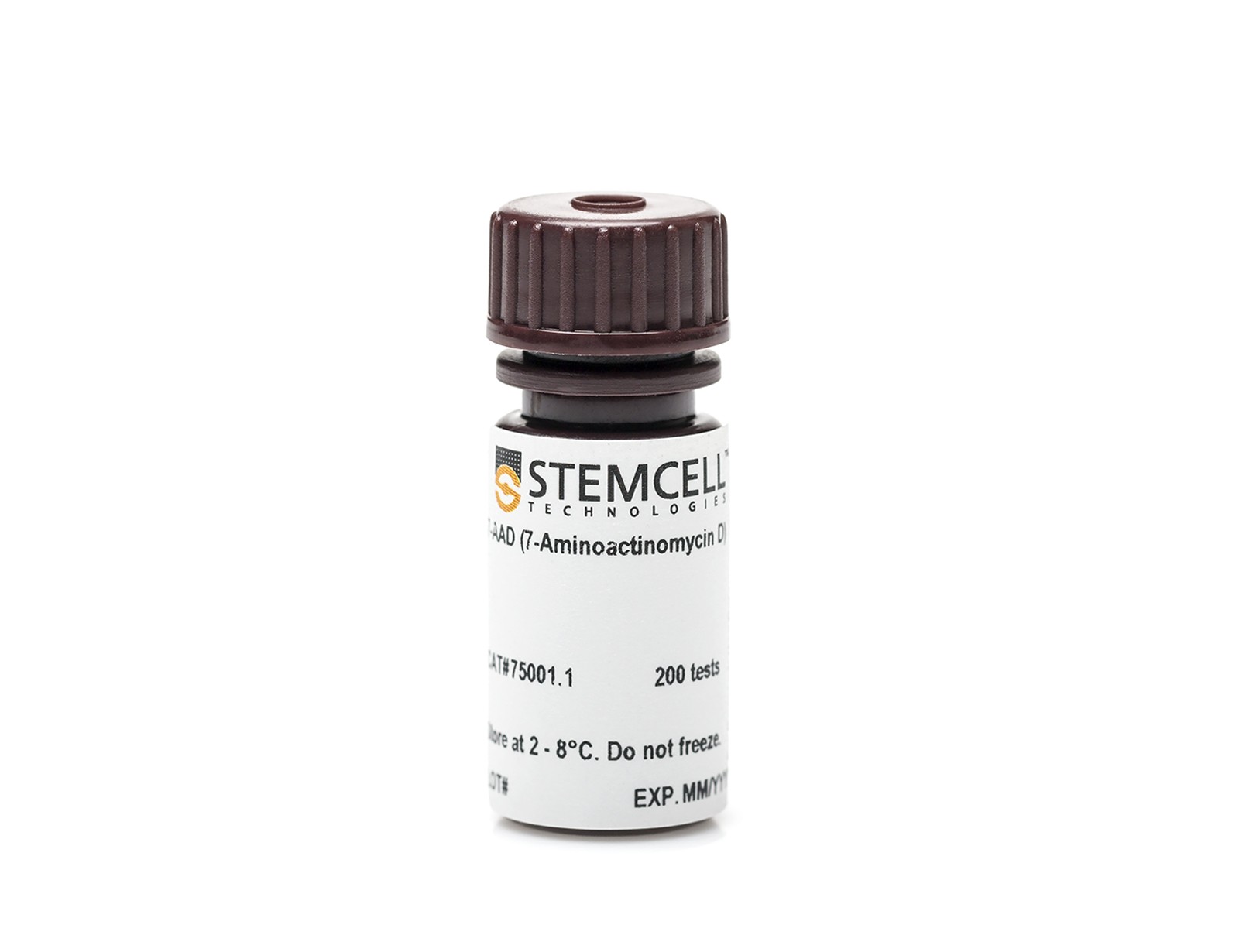
7-AAD (7-Aminoactinomycin D) Cell viability dye (DNA-labeling dye)
Overview
7‐AAD (7‐Aminoactinomycin D) is a fluorescent cell viability dye which is excluded from live cells with intact membranes but penetrates dead or damaged cells and binds to double‐stranded DNA with high affinity by intercalating between GC base pairs. It is often used as an alternative to propidium iodide (PI; Catalog #75002) to differentiate and exclude non-viable cells in flow cytometric analyses, and can be excited using 488 nm (blue), 532 nm (green), and 561 nm (yellow-green) laser lines. Compared to PI, 7-AAD offers the advantage of having minimal overlap in its emission spectra with mostly blue and green, and many red fluorophores, including the commonly used phycoerythrin (PE) and fluorescein isothiocyanate (FITC). 7‐AAD is also used in DNA fluorescence imaging applications to discriminate early and late stages of apoptosis, to study cell‐mediated cytotoxicity, and for chromosome banding analysis. 7‐AAD has been found to exhibit antibacterial properties and exhibits growth‐inhibitory activity against certain types of leukemia and sarcoma.
Application: Flow Cytometry; Immunocytochemistry; Immunofluorescence
Area of Interest: Neuroscience; Immunology; Stem Cell Biology
Chemical Formula: C₆₂H₈₇N₁₃O₁₆
Molecular Weight: 1270.4 g/mol